


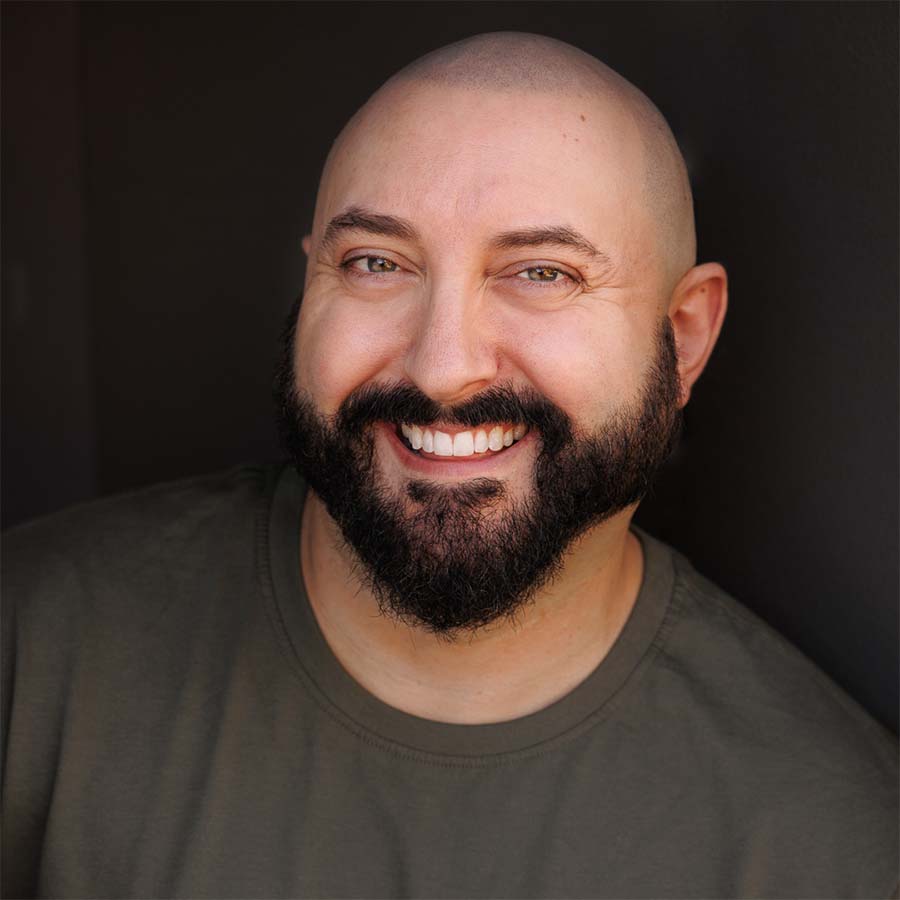


ShowHub Artist Spotlight: Dean Michael Smith
Dean Michael Smith Is Living The Dream
The first time I saw Dean Michael Smith, he was performing solo in a downtown dive bar. This particular bar (which will go unnamed here) is known amongst local musicians as a notoriously tough room, with many performers scarcely receiving a second glance from its patrons. I wandered in shortly before Dean played his last song, an acoustic version of Marc Cohn’s Walking In Memphis. As the last chords rang out through the woolly house speakers, I heard the room erupt into cheers and applause.
“Who is this guy?” I thought to myself. “And how did he just make that happen?”
It was no accident. Dean Michael Smith is a seasoned veteran of the entertainment industry, with experience in just about every discipline imaginable. Aside from a prodigious career as a working musician, Dean’s talents include screen acting, voice acting, production, and even mixed martial arts. He’s worked on both sides of the camera for countless projects, ranging from the early days of televised MMA to Ryan Gosling’s 2024 blockbuster summer flick The Fall Guy. You may even recognize Dean’s voice from such big-budget video games as Squad and CDF Starfighter.
In our conversation, we discuss the creative process, the reality of being a professional musician in Vancouver, and what kind of crocodile is most likely to kill you.
Meet the Artist
What was it like growing up in Australia? I know you did hockey, rugby, martial arts, softball…
I think that’s just how you grow up in Australia. Every kid comes out of the womb with a rugby ball.
Do the weak not survive in that country? I don’t think I’d make it.
I’m definitely not the right person to talk to about the Australian archetype, because the way I grew up was like, wading through crocodile-infested rivers with a semi-automatic rifle. My dad used to take us into the middle of nowhere. I remember… man, I was like 13 with an SKK, full banana clip… [Laughs.] I remember wading through water up to my neck, and looking at freshwater crocodiles on the bank, and being relieved that they weren’t saltwater crocodiles. Because the saltwater crocodiles are the ones that snatch you.
Yeah, the other ones are super friendly, I’m sure.
The other ones you’ll see coming.
When you weren’t cheating death, you spent your time in music and acting. Which discipline caught your eye first?
I think both, because they’re married. I was a massive Michael Jackson fan. Thriller? He made it a cinematic experience. Acting was always so tied in with music. Back To The Future, that score? Dude… Film and music were married, and martial arts too. It was kinda something my brother and I were always inherently doing. Anyone who knows me from those days, I’d always have a film camera, a guitar on my back, and a video camera.
Do you remember your first job as a kid?
My first job ever was working with Soundgarden. My aunt hooked it up. I remember the phone call. She said, “You owe me your firstborn. I got you a job working on this festival.” I was meant to be assisting in the backstage area, getting the riders together for all the bands: Soundgarden, Offspring, Fear Factory, The Prodigy, Patti Smith Band. And the two guys I was working with were like, “Oh, this kid’s doing a great job,” and just got stoned. I didn’t see ‘em again for the rest of the time I was there. So I was running the backstage area on my own.
And did you start writing around that time as well?
When I was a kid, I would make up stupid songs. I was a massive Ren & Stimpy fan, so it was just like, weird jingles. I’ve always been a massive comedy fan, and I would learn comedy songs verbatim, whole scenes from movies, and turn those into songs. I think I wrote my first proper emo song when I was maybe 15? I remember two dudes I knew at school were like, “We’re going into a professional studio, and we need a song!” So I ended up doing that, and that was my first time in a proper studio.
Your first album, Brave It Through The Night, came out in 2011, right?
Mm, yeah. I am overdue for a new one, that’s for sure.
What was it like recording that first record?
We spent the better part of a year in the studio. I got to work with one of my close friends, Adam, and we speak the same gibberish language. I can describe something to him, like “I want the sound of someone farting on a pickup under water in an Olympic swimming pool. But regulation size!” And he’d just dial it in straightaway. The people who owned the studio didn’t charge me anything. Craig and Elana Agnew, some of the nicest people I’ve ever met in my life.
Do those songs still hold up for you 15 years on?
I got lucky with that record, cause it came out exactly as I envisioned it. But I mean, I pick it apart to this day. I’m a way better musician now.
Is that just a part of being a creative?
I think so. I hate seeing myself on screen as well. I think it’s a healthy thing. If I know my scene’s coming up, I sink into my seat.
What does your writing process look like these days? Do you have to wait around for inspiration?
I used to be like that. But I know this about myself: hand me an instrument, and if I sit down with the intention to write, then something always comes out. So it’s consistency and progress over perfection. I think you need to embrace “killing your darlings.” I try to remove my ego from it as much as possible. A lot of people write for the audience, and man, that’s your first big mistake. Write for yourself, and then if other people like it, it’s a fucking bonus.
You’re working on a new album now, and you did a lot of the songwriting while staying in Kurt Cobain’s old house in Olympia, Washington. How did you swing that?
I had heard that you could rent the apartment where he wrote most of his material. The owner rents it out for a month at a time usually, but I asked, “Could I come down for a couple nights? I’m writing a new album.” And she said we could make that work. I walked into the place, and man, the energy in there is palpable. It felt like walking back into 1990. Nothing had really been changed.
Let’s talk about gigging. You moved to Vancouver in 2023, and you had no contacts in the local music scene. What was it like to rebuild your rolodex from scratch?
I don’t recommend it. It’s a bit of a psychotic plan. I didn’t really know that there was a music scene here. I just planned to come here, pick up some acting work, supplement that with some crew work. But that’s not possible — the crew hours are insane. 16, 17 hour days. It just rules your life. I headlined a festival within my first week of playing gigs here: The Blind Pig Festival. That was cool. I remember the hopeful feeling of “Oh, maybe this is gonna work out.”
How many shows did you play last year?
255. I could’ve broken 300, but we went to London. The year before that, I did more.
Any advice for up-and-comers who want to start gigging professionally?
If you do the hustle, you can make a living at being a musician [in Vancouver]. There’s constant turnover with bookers and venues, and you’re consistently trying to prove yourself. And it’s not always about talent… I think in North America it revolves around someone vouching for you. That carries more weight than having a swath of followers online.
Although that can help.
I think it’s important. I’ve worked hard on my social media. It’s like a virtual business card. And I think you gotta embrace that. As much as I kinda hate it. [Laughs.]
And at the same time as all this, your acting career just keeps getting bigger.
Yeah, I got signed about a month ago with Red Raven Talent, and I’ve been auditioning nonstop lately. I just got booked on my first “vertical” series! Vertical shows are currently a huge industry here in Vancouver.
I reckon a lot of people have heard your voice in video games, too.
I’ve worked on a few games. I worked on a Canadian game from Australia called Squad. I’ve done a lot of indie stuff, but the biggest one was CDF Starfighter.
You sure do make it all look easy.
From the outside looking in, it looks easy. It is not. Even now, with all the places I’ve played, I’ll still have venues ignore me. It’s still super hard, but you just gotta keep going.
Yeah, it’s definitely tough. But it can be rewarding too — people appreciate it.
One time, I was playing a gig [at UBC], and I didn’t think anyone was listening. This dude comes out of nowhere with a bottle of water, and he puts it down on top of a one hundred dollar bill. He gives me a subtle nod, and just cruises off. So you never know. That’s the thing with all art, you never know who you’re gonna touch.
Is that what keeps you coming back?
Yeah. You know, you think “Where’s this all leading, what’s this all for?” But the juice is worth the squeeze. When you have a great show, all the hustle and doubt is worth it. If you told your 10 year old self, “You’re gonna be making a living off of performing…” As humans, we’re always trying to look forward. It’s about perspective, though. We’re living other people’s dreams.
Singles from Dean Michael Smith’s remastered first album, Brave It Through The Night, are currently available to stream and purchase digitally. His next album is expected for release later this year.