


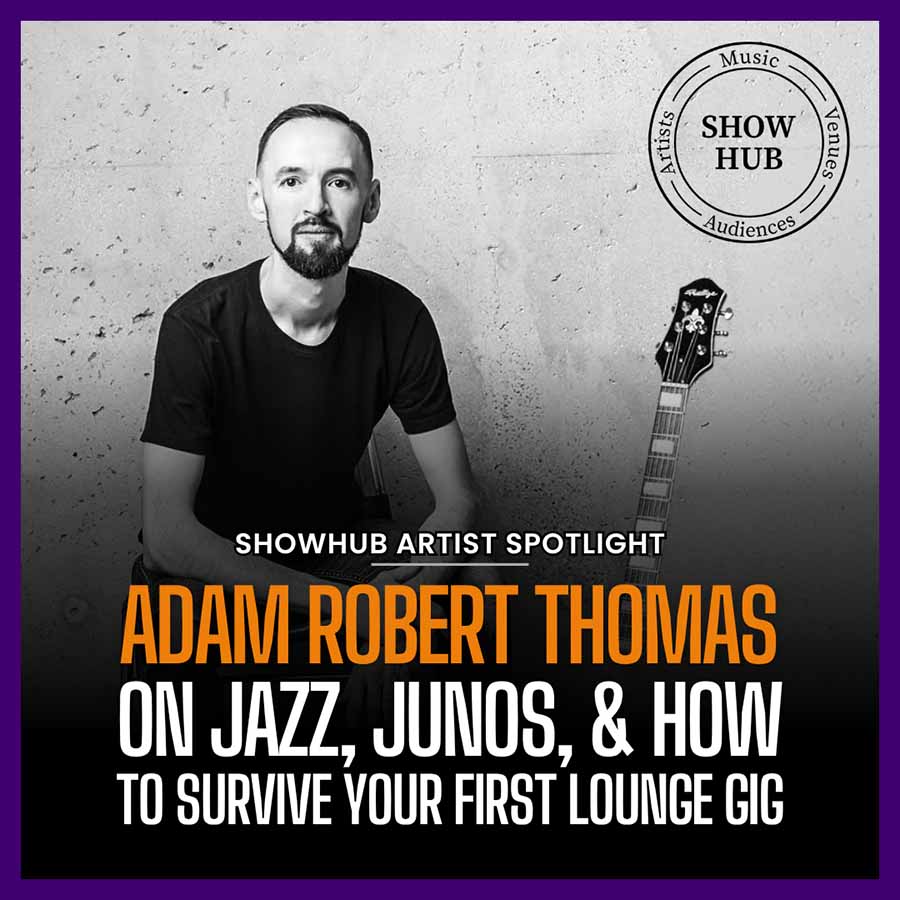


ShowHub Artist Spotlight: Adam Robert Thomas
The first time I met Adam, he came to me as a guardian angel. It was 2024, and I was working full-time as a solo musician in Vancouver. I had hitherto been playing almost exclusively in sweaty downtown pubs and sticky-floored student bars, but now I was trying to break into the lounge circuit. It was hard. I didn’t look the part, my pedal rig was fashioned out of plastic and duct-tape, and all the songs I knew were scream- along pub anthems.
On this particular night, I was performing at a swanky restaurant near Canada Place, and it wasn’t going well. I was sitting at the bar on my break, painfully aware of the thin ice cracking below me. By chance, Adam was sitting at the next stool over, and we got to talking. He must have intuited my desperation, because over the course of the next fifteen minutes, he gave me a crash course on how to succeed as a lounge musician, showing me how to adapt my sound to suit these fancier locales. I took his advice, and when we crossed paths a few months later, I had become a regular at that same venue and many more like it. Thanks, Adam.
Small wonder, too, that he knew so much about performing. Adam Robert Thomas is one of BC’s most prolific performers, playing more dates than nearly anyone else on the current circuit. As a musician, Adam’s credentials speak for themselves: he’s studied at two of North America’s finest jazz programs. He’s collaborated with an inexhaustible list of jazz icons, including Dan Brubeck, Laila Biali, and many more. He’s received multiple JUNO nominations, and his own solo album topped US charts in 2018. Most importantly, he’s cultivated a reputation amongst bookers and the public as a great guy to work with: polished, amiable to a fault, and always ready to have a good time.
In this interview, Adam reveals the tricks of the trade he’s accrued over his time on the music scene. TV show music placements, festival slots, local gigs — he’s seen it all. Whether you’re interested in pursuing music full-time, or are simply curious to learn more about the backstage drama of the music business, there’s plenty here to enjoy.
Meet the Artist: Adam Robert Thomas
Interview by Luc LeMans
I read that Chuck Mangione’s Feels So Good was the first album that really got you hooked on music. What does that record mean to you?
Chuck Mangione had come up as a young gun on the jazz scene, just as straight- ahead, formal jazz was starting to lose its public draw. But this was also when disco was coming online, and fusion, and some of the early smooth jazz artists like George Benson. So when I listen to Feels So Good, I realize: it’s a bunch of young guns who are just stoked to be playing something fresh and new. It’s disco jazz, and you can feel that they’re having a great time. Something about the energy and the vibe drew me to it as a kid… I still remember my dad miming along to the trumpet on the record.
And if you’re a jazz novice like me, that record is so accessible and easy to enjoy.
Yeah, one might say it “feels so good.”
Alright, this interview is over.
Sorry, sorry.
You mainly gig with a guitar these days, but your first instrument was trumpet?
Yeah, I had told my mom that I wanted to play jazz. She tried to get me guitar lessons, but this was the 1980s, and she couldn’t find a teacher who was willing to take an 8 year old student. So she found this guy who taught trumpet students. That was a horrible music education experience, I was in tears pretty much every time I went to lessons.
Oh man, you’re giving me flashbacks right now.
Well I didn’t realize it at the time, but I guess he was going through a nasty divorce, and they would be yelling up and down the stairs at each other during my lessons. So I never practiced, and that infuriated him even more.
You eventually switched to bass, right?
Right. I saw the upright bass in elementary school, and I wanted to play that. But they told me, “No no, you’re not tall enough.” So I started taking electric bass lessons instead. And those lessons were the exact opposite. My bass teacher was so chill, and just this beautiful, loving soul who really became a mentor to me. He saw my potential, and celebrated it in a way that made me believe in myself too. And I didn’t realize how key he was — or instrumental, if you will — in my personal development until years later. Bob Murphy and Kate Hammett-Vaughan were my two other mentors.
Did you eventually get your hands on one of those giant upright basses?
Yeah, at the end of high school, my grandpa gave me some money… I went to West Coast Music on Granville, and I ended up finding an upright bass, so I just bought it. Then at Capilano University, everyone needed bass players, and it allowed me to get a lot of hours in. And when I went to the University of North Texas, again, I was playing bass. Switching from trumpet to bass kinda opened all the doors.
How did you find yourself working with Dan Brubeck (Dave Brubeck’s son)?
After university, I went to New York for a few months. Eventually my visa ran out, and I went home to Vancouver. I actually quit playing bass for like 6 months, because I was burnt out and depressed. In New York, I was playing at a really high level, and then I got back to Vancouver, and there weren’t nearly as many players or gigs, so I got kinda bummed out.
Yeah, that’s a common tale.
But then Dan Brubeck moved to North Vancouver. Someone recommended me as a bass player, and he started calling me for gigs.
And at some point you must’ve told him, “You know I can sing too, right?”
I remember one gig, we were playing a tune and I said, “Hey, do you want me to sing this?” And he was like, “Uh… Sure?” He didn’t know yet that I really was a very competent singer. Meanwhile, he had wanted for years to put out a record to honour his mom and dad together. Because a lot of the classic Dave Brubeck tunes had lyrics to them that were written by Iola Brubeck, Dave’s wife. So the beginnings of a plan began to form. We would start playing some of these tunes on gigs, and finally we thought, “OK, let’s try to record this.”
And that album, Live From the Cellar, wound up earning you a vocal jazz JUNO nomination. What’s that JUNO experience like? Is there a limousine, red carpet…?
[Laughs.] No no no, it’s definitely not as fancy as you would think. The JUNO awards are kind of a business to promote business. So for example, an artist who has no nominations or awards will generally receive a certain fee for live shows. But then when you get a nomination, it adds to your credibility as an artist — in theory it increases your fee, and opens some more doors. With JUNOs or Grammys, it really just means, “Industry professionals say this is good.”
Speaking of your accolades, your 2018 album Adam Robert Thomas reached #11 on the US charts. To get there without a record label backing you is crazy.
Yeah, it is crazy. I received some grant money, and used it to pay an American radio promoter. For Canada, I did it all myself: I sent my album to every radio station I could find, independent or otherwise, and the radio promoter in the States had their own list.
Is there one song on that record that stands out for you?
Oddly enough, the track My Love that I buried at the end of the album was the one that had the most success. Someone heard it on the radio I guess, and they ended up using it for a series that was on the Oprah Winfrey Network. That was a major placement for an independent artist, and totally out of the blue.
That must have been a nice phone call to get.
I was so green to that whole process that I was totally a pain in the butt to the the guy who was arranging it for me. He was like, “Dude, I’m trying to help you out. You’re gonna get paid way more than you would ever get paid normally.” [Laughs.]
What do you think made that song so special?
It was one that really came from my heart, probably the most simple of the tunes on the record. I wasn’t trying to make any particular thing, I was just writing in that flow state. It was a good lesson — the track that was the most sincere on that album was the one that got the most traction.
Did you find that having a full album was helpful for landing festival slots?
The essence of that album was that I was trying to get festival slots! Prior to this album, I would submit my act to jazz festivals, and I would consistently get the same feedback, bookers saying, “It’s great music, but we have very limited room to book chill bands like yours.” For unknown artists, they tend to put you on free stages, largely outdoors. And they want high-energy, feel good music for that. So I intentionally wrote an album that was radio friendly: short tunes, upbeat, fun. Party music.
Let’s talk gigs. You’re one of the busiest live performers in BC. What do you do to keep your voice in good shape?
Oh good question… Well, I have, like, gears of intensity. If I’m playing at Guilt and Company, I’ll probably sing at 90 or 100 percent of my intensity. But for the vast majority of my gigs, that’s overkill for the room. It’s like, “Dude, we’re just trying to have a couple drinks here. We don’t need Steve Perry vocals right now.”
So you have to learn to pace yourself vocally.
Yeah, I pace myself and I’m usually singing in those lower gears. Not that I’m not giving to the room, but I’m also thinking, “What does this room actually need, energy-wise?”
Any other tips for avoiding strain on those longer gigs?
My loop station allows me to pace myself too. If it was just me, no loops, no drum machine, I don’t think I could keep the pace that I do. But because I’m playing electric guitar and I’m using loops, I can avoid repetitive strain injuries. And I can also switch between instrumental and vocal songs. If I’m coming back from a break and I’ve just eaten, I don’t have to slam right into it, I can play a couple instrumental tunes first.
For people interested in doing music full-time like you, is there a main pearl of wisdom you tend to offer?
Yeah, I’d start by asking yourself, “What does the customer need?” For example, I had a conversation years ago with our mutual friend Kelly, who used to book for one of the local agencies in town. I was a jazz guy, and I saw that O’Doul’s was closing, the Cellar was closing, and there weren’t a lot of places for jazz groups to play anymore. So I asked her, “How can I get gigs with you?” And she said, “Do you play guitar?” I was like, “Kind of…”
Right, because you were mainly a bass player at that time.
Right, and she told me, “Well, I can’t hire you just to play bass and sing, because it won’t work in most of the rooms we book. But if you can play guitar and sing, I can get you work as a solo act. Learn a handful of tunes from the last ten years, film a promo video, and I’ll get you some gigs.”
So you really had to modify your act to fit the lounge circuit.
Exactly, and that began the process of thinking, “OK, well what do people wanna hear?” And the word that came back every single time from the agencies was “upbeat.”
Oh yeah, I remember hearing that a lot when I was gigging.
Yeah, and this would happen to the jazz artists too, back in the 1930s and 40s. They would get told to “play the blues.” And that didn’t always mean 12 bar blues, it really just meant upbeat. Venues want music that feels good, has good pocket, simple melodies. Accessible stuff that’s recognizable.
How did you go about building a setlist?
I began a process of building a playlist that fit my own style of “upbeat.” I’m not Justin Timberlake or Bruno Mars, although I do try to stretch myself in that direction still too. My kind of upbeat is more laid-back Bob Marley vibes, some classic soul, maybe some yacht rock. And so I built a repertoire, a way of playing, that the bars and hotels were willing to pay money for, but that I also enjoyed too.
Did it take a while for all that to click?
I spent a lot of time hunting gigs, and trying to hustle gigs as a jazz player. And I’m sure I would’ve had a much better success rate if I just went into those restaurants, listened to their playlist, watched their customers, and said “OK, this is their vibe. I’m gonna curate a playlist and a promo video that fits this room.”
That’s good advice for working with booking agencies too.
Well again, you gotta ask yourself what the agencies need from you. And it’s usually pretty simple: show up on time, be communicative, try not to cause a problem with the venue. And don’t show up in shorts and flip-flops to a 5 star hotel. [Laughs.] If you can do all that, they’ll love you.
Adam’s 2018 album Adam Robert Thomas is available to stream on all major platforms.
Keep up to date on his upcoming by following his Instagram account, @adamrobertthomasmusic. Of course, you can also check his profile on ShowHub, where we have many of his shows listed.